Author Archives: danahoaglundarborist

Unknown's avatar

About danahoaglundarborist

I love trees. Over the last 36 years I have become quite familiar with trees. Largely during the time I was an ISA Certified Arborist (23 years), I learned to evaluate and prune trees, from the ground, ladders or by climbing with rope and saddle. I no longer climb, I now focus on smaller ornamental and fruit trees. Education and technique development are ongoing. Client education is an important and satisfying part of my job.

When is the best time to prune?

“When is the best time to prune is perhaps the most commonly asked question of an arborist, followed by “Is this a good time to prune?”  Seems like a simple reply should follow but the question is very open ended if examined with an open mind!

I recall a grafting demonstrator at a nursery field day replying the traditional answer was, “When the pruners were sharp.” That seemed to work pretty well, to a large degree, if the primary precepts of safe pruning cuts were adhered to. The first and foremost being, avoid making heading cuts – especially into 2 year or older wood; Do make THINNING cuts. Followed by, make cuts in a way that doesn’t damage wood of the trunk or branch remaining.

Okay, with a little reading or demonstration followed by some practice that was pretty easy. But the more I learned about insects and diseases affecting specific plant specie, genera and families depending on the season of the year, it was apparent many considerations were involved with the topic of when to prune. And since insects and disease cycles are affected most by the current weather, the answer changes daily.

Accordingly, you should expect a mix of answers and questions as thoughts regarding a useful time to prune develop.

I think it makes the most sense to treat each consideration with its own post.
When do I prune apple or Douglas Fir trees in the Olympia WA area?

When asked the question, “When is a good time to prune?”, I usually respond with, “Depends on the tree species, current health/past disease history, current weather/season of the year and type of pruning being considered.” (I used to try and be brief, giving 5 word answers until it was obvious that approach led to many more questions than answers.) That’s my way of giving a background to the “when to prune”  issue and letting it be known I need to get some answers of my own in order to accurately answer the question.

The final answer may be simple or complex depending on the tree’s biology, purpose, current and past health, season of the year and current weather.

For example, if I knew someone wanted to prune a Douglas Fir tree, I would ask them what they hoped to achieve from the pruning. Tree health, view enhancement, screening protection, aestetics, building clearance?

Removing dead wood can be done anytime. Removing 10-20% of the canopy would require knowing the time of year and current weather, the overall health and age of the tree and if summer irrigation is present. Depending on the above, there may be some more questions regarding soils, site exposure, type and health of nearby trees, etc.

Late October-March is the best all around time to prune Douglas Fir trees in Southwest Washington, as well as most other conifers. Soil moisture is favorable for bark beetle defense and egg laying is not active.

In the case of when is the best time to prune a fruiting or flowering tree (such as apple or crabapple)  I ask how important fruit and flowers are and the acceptible level of maintenance .

However, maples, apples, cherries, plums, however, are best pruned July-October, as are most other deciduous trees. Some varieties of Japanese Maples can be ready to prune in June if the weather is fairly dry.

Types and Importance of Branch Attachments

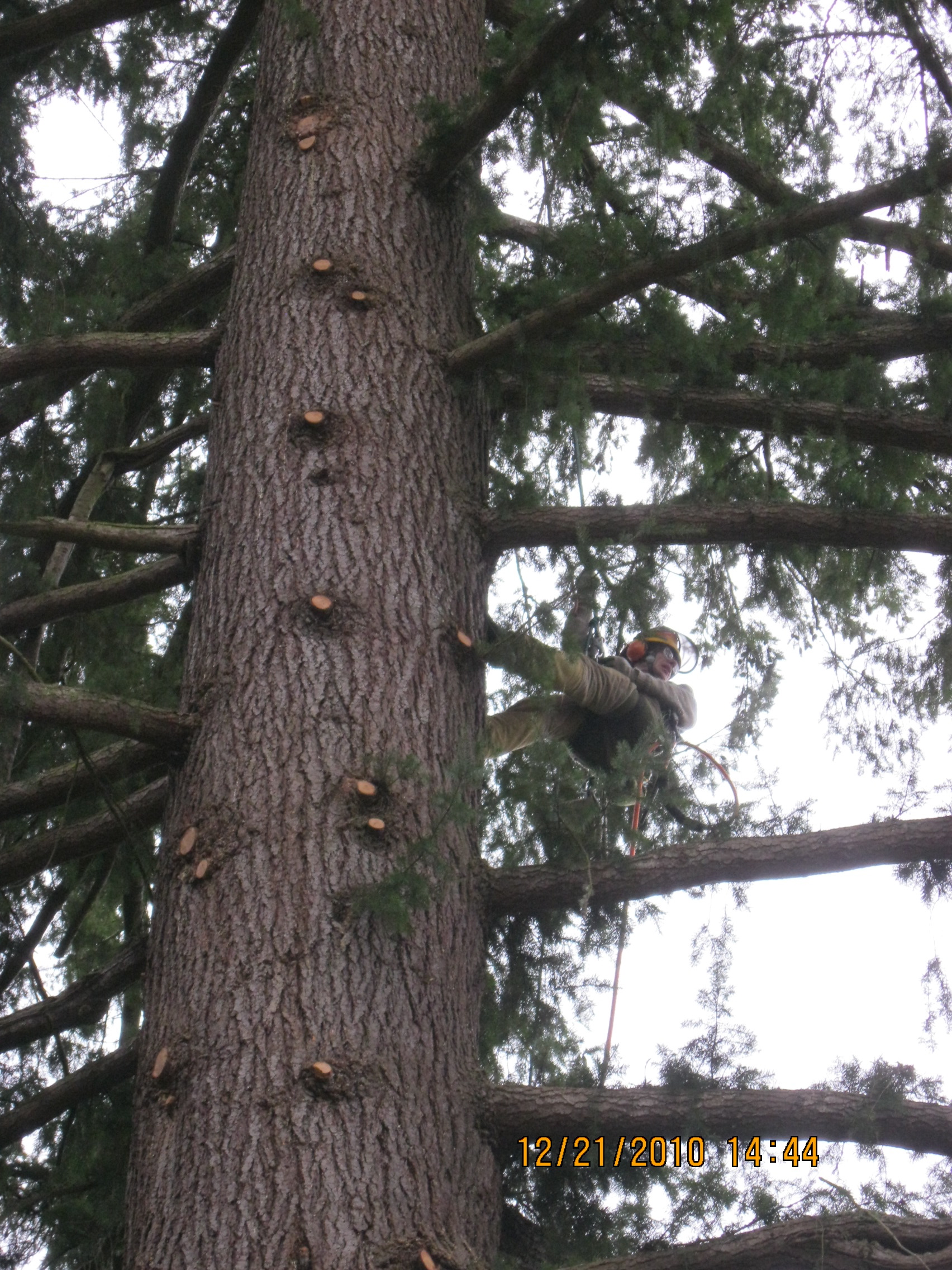
The central trunk of a conifer allows for strong branch attachments. Wind and rain usually snap a conifer limb without damaging bark on the trunk but snow and ice can pull a very strong limb out completely causing tearing of surrounding trunk wood and bark.

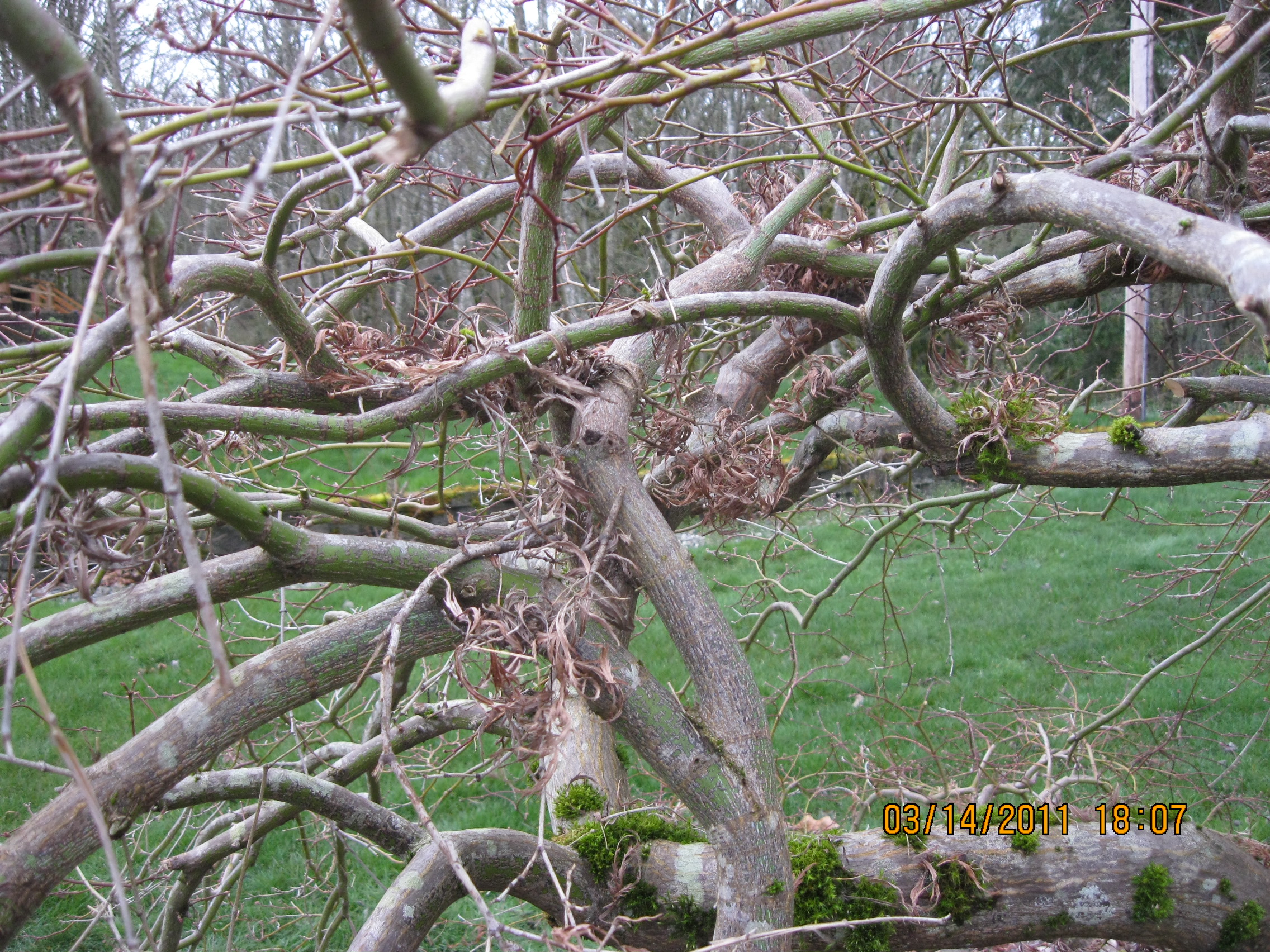
Weeping Japanese Maple with U and V shaped unions also displaying co-dominant situations. A U shape is stronger than a V. If the branches or trunks are similar in diameter the union will be weaker than one being larger. V’s are more prone to developing and or containing included bark which makes a weak attachment and can develop decay leading to branch failure. 

Right-angled branches

The central trunk of a conifer allows for strong branch attachments. Wind and rain usually snap a conifer limb without damaging bark on the trunk but snow and ice can pull a very strong limb out completely causing tearing of surrounding trunk wood and bark.


U and V-shaped branches

Weeping Japanese Maple with U and V shaped unions also displaying co-dominant situations. A U shape is stronger than a V. If the branches or trunks are similar in diameter the union will be weaker than one being larger. V’s are more prone to developing and or containing included bark which makes a weak attachment and can develop decay leading to    branch failure.

Branch union

U-shaped branch attachment

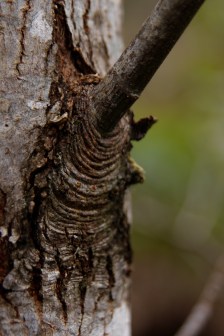
Branch showing solid attachment (union) to trunk and swelling of trunk as it makes room for branch. No bark of trunk or branch included in union.

Seasonal And Other Tree Lore

When talking about trees there are always comments to make based on cultivar or specie, age, season, weather and site. Various factors will periodically cross my mind as being potentially very useful to people owning, or caring for, trees within my geographical area of practice. Depending on circumstances of the moment, I will offer pertinent suggestions for learning more about trees and their care. Understanding a little bit about trees (and woody plants in general) is an excellent point of beginning.